
TLDR
- Data-driven design helps teams connect user behavior, business goals, and project decisions before AI becomes part of the work.
- Analytics can reveal what people are doing, but research, discovery, and human judgment are needed to understand why.
- AI becomes more useful when it has clear goals, relevant data, direct user insight, and practical project context to work from.
- The first AI output should be treated as working material that the team reviews, questions, and improves through iteration.
- Quality depends on owning the full process, from finding what is true at the beginning to measuring performance after launch.
AI is accelerating how fast we can design, but not how deeply we understand who we’re designing for. We're in a moment where design teams can generate interfaces, content, and full site structures in seconds (and many of them are doing just that). But faster output without a clear direction isn't progress; it's well-formatted guesswork.
Data-driven design brings that context into the process. It means interpreting analytics, user research, customer feedback, and business goals together to understand what people need, how a product can support them, and which direction they should take.
AI is only as useful as the information it is given. A language model can’t inherently understand a company’s goals, its customers, or the conditions shaping their decisions. The project team brings that knowledge to the process and uses it to guide their work.
What Is Data-Driven Design?
Data-driven design means using real information about your users and your business to guide design decisions. That can include analytics, user research, customer feedback, and conversations with the people who use the product.
Together, those insights mean teams understand what people need, where they are getting stuck, and what should be improved. It gives everyone a clearer foundation for deciding what to build, how it should work, and why.
This approach allows teams to use AI with greater intention. It connects the speed of the tools with a shared understanding of the people the experience needs to serve.
Why User Data Still Needs Human Interpretation
Data can show us what users do within an experience. Understanding why they do it requires a closer look at the full customer journey, the goals of the business, and the context surrounding each decision.
Analytics, discovery, and human judgment build a fuller picture of what is happening. The process starts by reviewing patterns in user behavior, gathering supporting information, and considering what those findings reveal about the customer’s needs.
Depending on the project, our discovery process may draw from:
- Behavioral data: navigation paths, conversions, internal searches, and session recordings
- Search and technical data: Google Search Console, Ahrefs, Screaming Frog, etc.
- Direct customer insight: interviews, support conversations, and stakeholder discussions
Each source answers a different part of the question. Together, that data shows how people move through the experience, what they intend to accomplish, and where they may need more clarity or support.
AI can identify and organize patterns within the information it receives, but human insight gives those findings meaning. The project team brings an understanding of customer motivations, business history, internal knowledge, and practical constraints that may not appear in the data alone.
With that context in place, AI can organize research, compare themes, and explore possible directions grounded in the real experience. This gives the team more time for creative thinking and strategic decision-making.
The same principle applies at an organizational level. Access to AI tools doesn't automatically create business value; companies also need the workflows, data, and decision-making structures that allow those tools to support meaningful work towards understood goals.
McKinsey’s 2025 State of AI report found a wide and growing gap between companies using AI and companies actually seeing measurable returns from it. 88% of respondents said their organizations regularly used AI in at least one business function, while only 39% reported an enterprise-level impact on earnings before interest and taxes.
Organizations reporting the strongest results were more likely to redesign workflows around AI and connect the technology to broader business transformation. AI is a valuable tool, but the value it can offer depends heavily—if not entirely—on the goals, data, workflows, and human perspective guiding how it’s all used.

How Data Shaped the DeckMate Relaunch
We saw this process come to life while working with DeckMate, a boat seat and marine component manufacturer with a family of focused ecommerce sites serving pontoon owners, bass boat owners, flooring customers, and shoppers looking for a broader range of marine seating.
The company wanted to bring those experiences together through a relaunched DeckMate.com, designed around complete boat renovation projects. The new site needed to guide customers in shopping for seats, flooring, accessories, and other components across several types of boats.
The business goals and product catalog gave us a starting point. User behavior gave us insight into how customers expected to find what they needed.
What the Data Revealed
We reviewed homepage paths, navigation behavior, product traffic, and internal site searches to understand how customers were approaching the existing experience.
Bass boat seats received more than twice the traffic of any other category, followed by fishing boat seats, back-to-back seats, and pontoon seats. Customers also opened the internal search tool hundreds of times from the homepage, often using it as a direct route to specific products, which suggested that some items were difficult to find through the existing navigation.
Together, those patterns showed us that customers often began with the type of boat they owned, then looked for the seating, flooring, and other components that fit it.
The Direction It Created
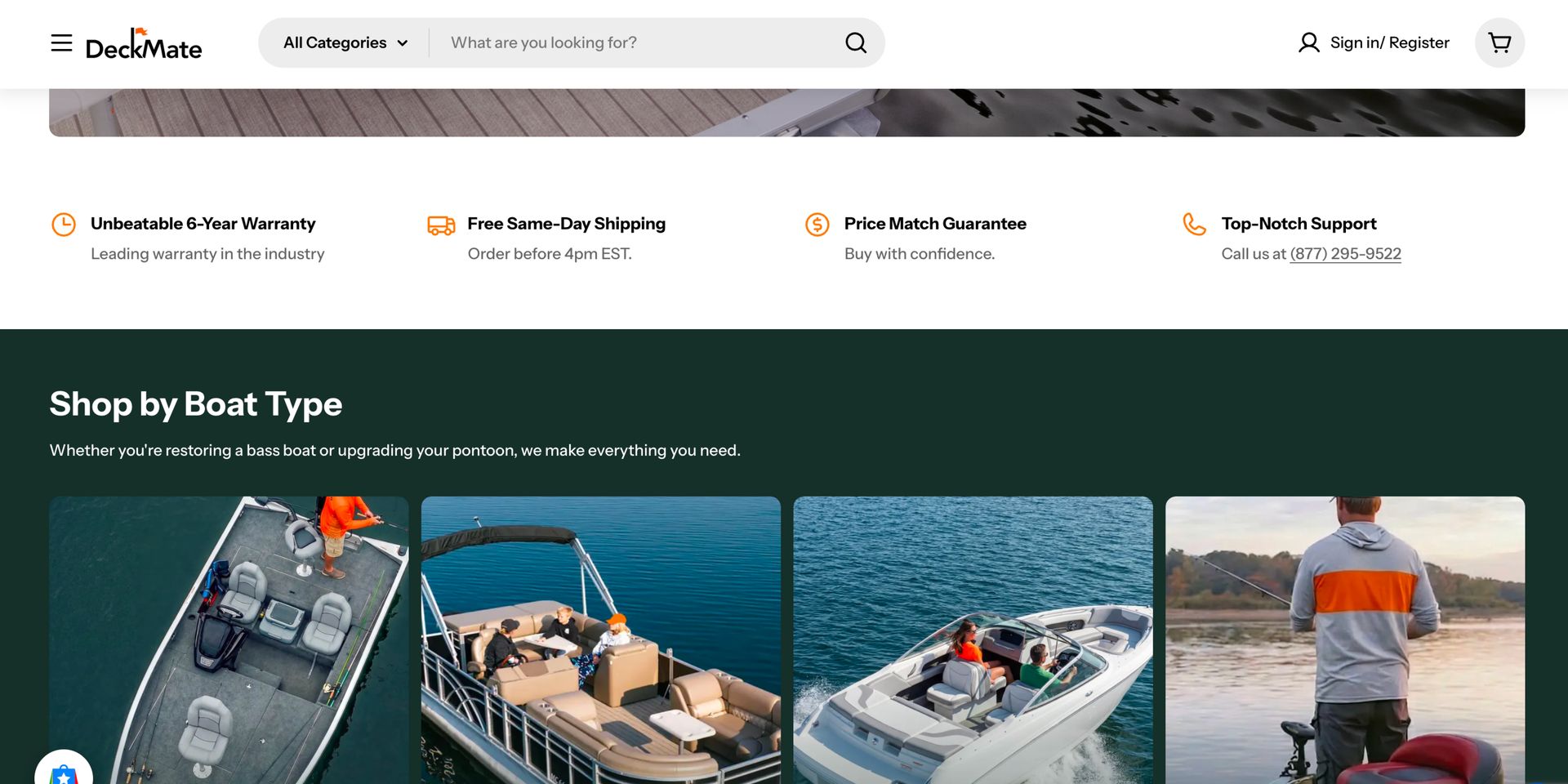
That behavior shaped the new site structure. The homepage became a navigation hub that gave customers a clear and simple place to begin: their boat type. Bass boats, pontoons, bowriders, and fishing boats became clear entry points into the catalog, allowing customers to move from the boat they own to the products designed for it.
Flooring also earned a place in the top-level navigation because traffic and search behavior showed that many customers arrived with that specific project in mind.
The team aligned around a clear principle: the site should reflect how boat owners naturally think about a rebuild. Start with the boat, then guide them toward the seating, flooring, accessories, and components that fit it.
That understanding guided the information architecture, page hierarchy, content, development, and SEO strategy. It also gave everyone involved a reason behind the decisions being made.
The Early Results
During the first month after the April 7, 2026 launch, the site recorded:
- 1,652 orders, compared with 496 during the benchmark period
- Total sales more than double the benchmark
- An 81% increase in organic search sessions
- Bass boat seats remain the highest-traffic destination
The increase from 496 to 1,652 orders represents growth of approximately 233%.
AI supported the team by organizing information, exploring ideas, and moving through execution more efficiently, but the direction for the project came from human understanding of the relationship between customer behavior, business goals, and the experience boat owners needed.
What an AI-Ready Design Foundation Includes
The DeckMate relaunch began with a clear business goal and information connected to a specific customer experience. That gave the team the context needed to make informed decisions before AI became part of the workflow.
An AI-ready design foundation brings together the information a team needs to understand the customer, evaluate possible directions, and connect design decisions to the larger goal of the project.
A Defined Business Outcome
Every project should begin with a clear understanding of the change it needs to support.
That could mean helping customers find the right product, increasing form completion, improving onboarding, reducing support requests, or making a complex service easier to understand.
A defined outcome helps the team identify which information will be most useful and evaluate whether a proposed direction supports the project as a whole.
Relevant Behavioral Data
The team then needs evidence connected to that outcome.
Depending on the project, that could include navigation paths, internal site searches, conversions, drop-off points, search queries, session recordings, or repeated support requests.
The most useful source depends on the behavior the team is trying to understand. Collecting more information doesn’t always lead to a better decision. Rather, the goal is to focus on the data that can help the team understand the experience in front of them.
Direct User Insight
Behavioral data becomes more useful when teams connect it to the experiences and expectations of real people.
Customer interviews, usability testing, sales conversations, surveys, and support interactions give insight into the motivations behind a pattern. They also capture the language people use when describing their goals, questions, and frustrations.
This language can later support AI-assisted content, interface copy, research synthesis, and ideation because it reflects the way customers actually describe the experience.
AI-generated personas and synthetic users can contribute to early exploration by helping teams organize existing information or develop hypotheses for future research. They should be treated as working tools rather than evidence of what real people think or do.
Research from Nielsen Norman Group found that synthetic users often produce shallow or overly positive responses and cannot reflect the full complexity of real user opinions. The researchers recommend using them for early activities such as desk research and hypothesis development while continuing to conduct research with real people.
Business and Project Constraints
Every project has practical boundaries. Budget, technology, operations, regulations, brand standards, available content, and internal workflows all shape which ideas can realistically move forward.
Bringing those considerations into the process early gives the team a more accurate starting point for exploring possible directions.
Shared Decision Criteria
The team also needs a common understanding of what good work should accomplish.
Designers, developers, strategists, marketers, and stakeholders should all be aligned around the user, the business goal, and the intended experience. That alignment gives everyone a consistent way to evaluate whether an AI-assisted direction supports the project.

Discovery Creates Shared Context
Discovery brings the most useful project information together so the team can build a communal understanding of the organization, their customers, and the problem they’re working to solve.
That can include stakeholder conversations, user research, analytics reviews, search data, technical analysis, product information, and competitive research.
The right mix depends on the project and the decisions the team needs to make.
Through discovery, teams can better understand:
- How customers describe their needs
- What people are trying to accomplish
- Where they experience friction
- What the business needs their digital experience to support
- Which practical considerations will shape the process
This shared context gives AI more specific and useful source material. It also gives the project team a consistent way to review the ideas, summaries, and recommendations those tools produce. Teams can test assumptions, review performance, and update the information guiding the experience as the product, business, and customer needs evolve.
Discovery Helps Teams Understand What the Data Means
The risks of moving ahead without this context extend beyond the design process. Gartner predicts that through 2026, organizations will abandon 60% of AI projects unsupported by AI-ready data.
AI can identify a pattern in the information it receives. It may show that customers are leaving during checkout, for example. The pattern alone can't explain why users are leaving. Maybe they encountered an unexpected shipping cost, felt uncertain about the site, struggled with a long form, or simply left for a reason unrelated to the experience.
Each explanation would lead the team toward a different response. Shortening the form may help when the form itself is creating friction. It will do little when customers need clearer delivery information, greater confidence in the product, or more visibility into the final cost.
Discovery helps teams interpret what a pattern may mean before deciding how to respond. Direct conversations, observed behavior, and business knowledge give the team the depth needed to form stronger hypotheses and choose what to investigate next.

Quality Comes From Owning the Full Process
At Nextpoint Studio, we think of our role as beginning before AI enters the process and continuing after its output becomes part of the work. We treat AI as a useful tool rather than a replacement in the process while keeping our work grounded in real user behavior, business context, and the judgment of the people closest to the project.
The beginning is about finding what is true. We look at how people actually use the experience, what the business needs it to support, and what the available research and data reveal.
That understanding comes from discovery, direct conversations, observed behavior, and careful interpretation. It can’t be produced through a prompt alone. It develops through the process of learning about the customer, the organization, and the conditions shaping the project.
AI supports the work in the middle. It can help us organize information, explore, refine, and move more efficiently. Its value grows through iteration.
The team provides context, reviews the response, identifies weak assumptions, adds what is missing, and continues refining. The first output becomes material for the team to assess rather than a finished answer.
The end of the process belongs to the team as well.
The end is about accountability. We stay involved through launch and measurement, reviewing performance and learning whether the experience is supporting the people and business it was created for. Those findings become part of the next round of decisions.
Our clients should be able to see that our work is helping their business move forward. That requires more than simply delivering an interface or launching a site. We stay close to the data, test assumptions, and take responsibility for how the experience performs over time.
Data-driven design in the age of AI begins with understanding and continues through accountability. AI can accelerate the work between those points, building on the research, judgment, and direction the team has established.
At Nextpoint Studio, we bring strategy, design, development, and marketing into the same process. We help teams turn user behavior and business goals into a clear direction for websites, platforms, and digital products.
Bring better context into your next redesign, relaunch, or digital product. Tell us what your team is planning. We’d love to help you do it well, not just fast.



'%3e%3cg id='Final-Copy-2_2_' transform='translate(1275.000000, 200.000000)'%3e%3cpath class='st0' d='M7.4,12.8h6.8l3.1-11.6H7.4C4.2,1.2,1.6,3.8,1.6,7S4.2,12.8,7.4,12.8z'/%3e%3c/g%3e%3c/g%3e%3c/g%3e%3cg id='final---dec.11-2020'%3e%3cg id='_x30_208-our-toggle' transform='translate(-1275.000000, -200.000000)'%3e%3cg id='Final-Copy-2' transform='translate(1275.000000, 200.000000)'%3e%3cpath class='st1' d='M22.6,0H7.4c-3.9,0-7,3.1-7,7s3.1,7,7,7h15.2c3.9,0,7-3.1,7-7S26.4,0,22.6,0z M1.6,7c0-3.2,2.6-5.8,5.8-5.8 h9.9l-3.1,11.6H7.4C4.2,12.8,1.6,10.2,1.6,7z'/%3e%3cpath id='x' class='st2' d='M24.6,4c0.2,0.2,0.2,0.6,0,0.8l0,0L22.5,7l2.2,2.2c0.2,0.2,0.2,0.6,0,0.8c-0.2,0.2-0.6,0.2-0.8,0 l0,0l-2.2-2.2L19.5,10c-0.2,0.2-0.6,0.2-0.8,0c-0.2-0.2-0.2-0.6,0-0.8l0,0L20.8,7l-2.2-2.2c-0.2-0.2-0.2-0.6,0-0.8 c0.2-0.2,0.6-0.2,0.8,0l0,0l2.2,2.2L23.8,4C24,3.8,24.4,3.8,24.6,4z'/%3e%3cpath id='y' class='st3' d='M12.7,4.1c0.2,0.2,0.3,0.6,0.1,0.8l0,0L8.6,9.8C8.5,9.9,8.4,10,8.3,10c-0.2,0.1-0.5,0.1-0.7-0.1l0,0 L5.4,7.7c-0.2-0.2-0.2-0.6,0-0.8c0.2-0.2,0.6-0.2,0.8,0l0,0L8,8.6l3.8-4.5C12,3.9,12.4,3.9,12.7,4.1z'/%3e%3c/g%3e%3c/g%3e%3c/g%3e%3c/g%3e%3c/svg%3e)